Early Warning, Alert and Response System (EWARS)
It is a simple and cost-effective way to rapidly set up a disease surveillance system.
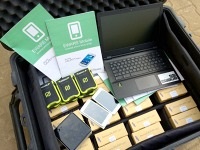
"EWARS in a box" contains all the equipment needed to establish surveillance and response activities, particularly in difficult and remote field settings without reliable internet or electricity.


EWARS Mobile: quick start guide
EWARS Mobile: mobile user guide
This Mobile user guidance is aimed at supporting implementation of EWARS Mobile (formerly EWARS-in-a-Box), WHO’s electronic early warning, alert...
Populations affected by emergencies are continually at risk of outbreaks of epidemic-prone diseases and other public health hazards. This operational guidance...

EWARS Mobile can still come "in a box"
Where smartphones and computers are not already readily available, EWARS Mobile can still be brought to the field as a complete hardware package. This kit contains all the equipment needed to establish surveillance and response activities, particularly in difficult and remote field settings without reliable internet or electricity.
The box contains 60 mobile phones, laptops and a local server to collect, report and manage disease data. A solar generator and solar chargers allow the phones and laptops to function without 24-hour electricity. A single kit costs approximately US$ 15 000 and can support surveillance for 50 fixed or mobile clinics serving roughly 500 000 people.
EWARS is deployed during an emergency as an adjunct to the national disease surveillance system. WHO works with Ministries of Health and health sector partners to train local health workers to use the system. After the emergency, EWARS should re-integrate back into the national system.
Video


Events
Publications
In this edition of WHO's Operational Update on Health Emergencies, highlights of country-level actions and WHO support to countries include:EWARS in a...
Monthly operational update on health emergencies - August 2023
In this edition of the Monthly Operational Update on Health Emergencies, highlights of country-level actions and WHO support to countries include:WHO supports...
Features
Related news